Saturday, 18 December 2010

#91 The Grapes of Wrath, by John Steinbeck (Penguin Group)

Well, it's finished. No, not the challenge, but my reading of The Grapes of Wrath - a Pultizer Prize-winning novel and acknowledged American classic. But I found it awfully hard-going at the start.

I love author John Steinbeck, and Of Mice and Men is among my favourite novels, but I've always been a bit daunted by The Grapes of Wrath, as much for its sweeping look at the Great Depression as its not insignificant length. Suffice to say, I've renewed this book no fewer than five times since I withdrew it from the libary in mid-October...

But the book itself is a masterpiece. While it's relatively easy to portray events - if difficult to do it well - to create a mood is much harder, and to create one which so pervades the novel a barely believable triumph.

The Grapes of Wrath begins with despair and fear as the Joad family leaves the Oklahoma dustbowl and year after year of failed crop harvests in search of work in the promised land of California, and relates how they hang on to hope in spite of the hardship and sacrifice they encounter.

It's a 'hard' book in many ways. The suffering is huge, while the language is so evocative that the reader feels like the family, making progress so slowly that persistence and resilience are required in abundance. Every alternate chapter gives a short overview of the plight of families like the Joads and reinforces the magnitude of their plight in the 1930s.

And yet. Despite the fight for food, the lack of work, the absence of a home, the ill treatment by police and Californian residents, strikes, the gruelling nature of the pilgrimage west, illness and even death, The Grapes of Wrath is above all an inspirational story of hope and how family and human nature can overcome almost anything.

I could go on, but I'll limit myself to one more word: excellent.

So, rating time:

#91 The Grapes of Wrath, by John Steinbeck (Penguin Group) - 9/10

Next up: The Five People You Meet in Heaven , by Mitch Albom (Little, Brown)

  • Click here for the full list of books so far, and their rating
  • Tuesday, 7 December 2010

    #90 Mortal Causes, by Ian Rankin (Orion)

    You know you're in safe hands with Detective Inspector John Rebus, not to mention his creator, Ian Rankin.

    It's easy to dismiss a series such as this as straightforward crime novels. It's indisputable that that's what they are. They're relatively easy to read and very entertaining, but that wouldn't be giving Rankin nearly enough credit, because it takes great skill to construct something as simple and effective.

    Over the years, I've dipped in and out of the Rebus series, to the extent that I'm never quite sure which ones I've previously read. That it doesn't really matter where in the series you enter, and that each novel brings a huge amount of satisfaction and pleasure, probably explains why I keep returning.

    Rankin's chief success lies in his depiction of Edinburgh, as much a character in his books as Rebus himself. And in a world where the latest book, television programme or film contains so many twists and turns at every corner that it leaves you wondering which way you're facing, Rankin's low-key plotting and gradual reveal makes a nice change.

    Not that there aren't a few shocks. The world Rebus inhabits - in the case of Mortal Causes, one where paramilitary terrorist activity is encroaching on the detective's world - is a nasty one, full of murder and violence, lying and cheating, much of it conducted by Rebus himself.

    But Rebus always remains the man you'd like out on the streets tackling crooks on your behalf - just as long as we can read all about it.

    So, rating time:

    #90 Mortal Causes, by Ian Rankin (Orion) - 7/10

    Next up: The Grapes of Wrath, by John Steinbeck (Penguin Group)

  • Click here for the full list of books so far, and their rating
  • Sunday, 5 December 2010

    #89 Breathing Lessons, by Anne Tyler (Vintage)

    After reading The Accidental Tourist, I told my More Literary Work Colleague that I hadn't been hugely impressed with Anne Tyler, only to be be put firmly in my place, to the extent that I felt inclined to give another of her books a go. Breathing Lessons was that book.

    It was both an improvement and an interesting read - not least because for the first time this year, I've seen something of myself in one of the characters.

    Breathing Lessons revolves around one day in the life of the ever-optimistic yet misguided Maggie, who cannot help meddling in the lives of those around her. She thinks nothing of telling a tiny lie if she believes it will reconnect her son with his errant wife and child, and as the novel progresses, it becomes clear that similar small mistruths in the past have led to this unfortunate and unhappy point.

    Maggie's husband is the stoic Ira, a quiet man who tries to get on with life, is keen to avoid arguments, is happy to accept situations which have developed and believes it is pointless to try to change the past. I identified with him a lot.

    The events related within Breathing Lessons are quite mundane - going to a funeral, going to see your grandchild, dealing with family illness - but the realism of the relationships which are portayed is what makes the novel worth reading.

    So, rating time:

    #89 Breathing Lessons, by Anne Tyler (Vintage) - 7/10

    Next up: Mortal Causes, by Ian Rankin (Orion)

  • Click here for the full list of books so far, and their rating
  • #88 No and Me, by Delphine De Vigan (Bloomsbury)

    Unable to get to the library after running out of books to read, I actually had to invest in a new book to maintain my momentum as the final month of this challenge approached. I didn't have much time, I was only able to dash into a WH Smith while collecting some contact lenses from the store opposite, and the novel I ended up with was No and Me.

    The last time I hastily selected a book emblazoned with a sticker denoting it had been chosen by Richard and Judy's Book Club, I was rewarded with a novel of surprising excellence: How to Talk to a Widower, which I've praised many times before. Unfortunately, No and Me didn't have quite the same impact.

    Despite having previously studied French Literature and the likes of Moliere and Camus, I read the translated version, and I'm afraid I was left a bit disappointed.

    The tale of a child genius, Lou, who befriends and starts to care for a homeless girl, No, after she agrees to help her with a school project, it's by no means bad or without interest. But for a book which has homelessness as its main subject, it's a bit too light and frothy for my taste, not grimy enough at all. Indeed, I've since been interested to learn that this was marketed as an adult book in France, but has been targeted at the more teen and chick-lit market in this country.

    There are some nice touches. The impact of No on Lou's family and how she helps them to heal while her own life continues to disintegrate is a poignant contrast, and I enjoyed Lou's random experiments on everyday objects.

    But while their relationships between the duo, and older, cooler friend Lucas ring true, I can't help feeling the way the story puts a lot of emphasis on the fact the Lou has an incredibly high IQ of 160 for a 13-year-old is partly used by the author to get around the issue of her precocious language, which never seems realistic.

    So, rating time:

    #88 No and Me, by Delphine De Vigan (Bloomsbury) - 6/10

    Next up: Breathing Lessons, by Anne Tyler (Vintage)

  • Click here for the full list of books so far, and their rating
  • #87 Sharpe's Company, by Bernard Cornwall (Harper Collins)

    A friend of mine, Big Gay Rob, swears by Sharpe (almost more than Sharpe does himself in the novels). His girlfriend doesn't mind; she reckons Sean Bean, who played Richard Sharpe in the television series of the books, is 'all man'. And I have to admit that, after finishing Sharpe's Company, I can't argue with either point of view.

    Sharpe's Company is the proverbial right rollicking read. You're never more than a heartbeat away from another battle, another betrayal, another beautiful woman to catch Sharpe's eye amid the never-ending plot and intrigue of an army at war.

    The focus of this book is the Siege of Badajoz in Spain in the early 1800s, and things aren't going well. Sharpe's lost his captaincy and is being bated by an enemy within the ranks, while the battle isn't going any better...

    That he's going to come through it all is never in any doubt, and there is very little to surprise readers. But there is plenty of frenetic fun and excitement en route as Sharpe bests what appear to be insurmoutable odds to win the battle, protect his woman and rid the army of (a bit of) corruption.

    The above is all well and good, of course. But even as a relative newcomer, I know author Bernard Cornwell prides himself on his historical accuracy, and the authenticity of the setting and the events combines with even the most outlandish plot to produce a very enjoyable book.

    So, rating time:

    #87 Sharpe's Company, by Bernard Cornwall (Harper Collins) - 8/10

    Next up: No and Me, by Delphine De Vigan (Bloomsbury)

  • Click here for the full list of books so far, and their rating
  • #86 The Heart of a Goof, by PG Wodehouse (Everyman's Library)

    Another PG Wodehouse, and another book from the great man about sport, but this time it's golf which is the focus of The Heart of a Goof.

    Earlier this year, I read a book devoted to Wodehouse's love of cricket and the effect of the sport on his work. It now seems surprising that there was no mention of golf, because Wodehouse clearly has a deep affection for the game, and, in a foreword, even mounts a vociferous defence against any potential criticism that he is wasting words on what some might consider an inconsequential subject.

    As if I didn't like Wodehouse enough already, he points out that it's through golf and other sports that real drama is created and is most truly evident. Which is exactly the argument I make to the Wench when I want to watch a significant sporting event...

    But enough of that. The book itself is a collection of short stories, but has the neat trick that each is introduced and related by the same person, 'the Oldest Member' of a golf club, who adroitely traps someone into listening to his latest tale. With some of the stories also containing the same characters, it never feels like a simple compilation, though, and there is plenty of progression and real character depth.

    You're never far from a humorous situation with Wodehouse, and of all the authors I have read this year, there isn't one who is easier to read and who makes turning the pages such an reflex action - and so enjoyable.

    So, rating time:

    #86 The Heart of a Goof, by PG Wodehouse (Everyman's Library) - 8/10

    Next up: Sharpe's Company, by Bernard Cornwall (Harper Collins)

  • Click here for the full list of books so far, and their rating
  • Friday, 3 December 2010

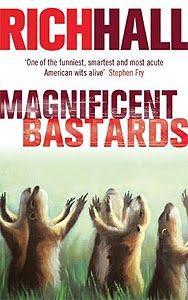
    #85 Magnificent Bastards, by Rich Hall (Abacus)

    I'm a big fan of the stand-up comedy of Rich Hall, one of the more intelligent and laconic comedians on the current circuit, but Magnificent Bastards, his collection of tall tales, didn't inspire the same pleasure.

    It's perfectly fine, and there are some nice touches within the short stories, particularly with regard to the creation of some quirky characters. But the collection is quite disparate and never really gels together to become a greater sum than its parts.

    The best story is of a man who vacuums prairie dogs as he plots to reclaim his family home, but on the flip side there is a bizarrely hyperbolic tale of a girl who invites 45,000 MySpace friends to a party at her house.

    So, rating time:

    #85 Magnificent Bastards, by Rich Hall (Abacus) - 6/10

    Next up: The Heart of a Goof, by PG Wodehouse (Everyman's Library)

  • Click here for the full list of books so far, and their rating
  • #84 What the Dog Saw, by Malcolm Gladwell (Penguin Books)

    Giving it 10/10 probably tells you all you need to know, but further evidence of how much I liked Malcolm Gladwell's Outliers is the fact that I more or less went straight out and bought another of his books, What the Dog Saw.

    It's not as good. But that's like comparing Asafa Powell to Usain Bolt. In anyone's terms, when it comes to running very quickly indeed, Powell is outstanding. But he's not Bolt.

    Anyway, metaphors aside, it's a fascinating read, as Gladwell turns his attention to finding interesting stories in apparently any mundane subject he puts under his microscope, whether it's the failure of companies to compete with Heinz's Tomato Ketchup to what hair dye advertising did for the empowerment of women, which was my favourite tale, and the dangers of over-analysing decisions with the benefit of hindsight.

    So, rating time:

    #84 What the Dog Saw, by Malcolm Gladwell (Penguin Books) - 8/10

    Next up: Next up: Magnificent Bastards, by Rich Hall (Abacus)

  • Click here for the full list of books so far, and their rating
  • #83 The Wire Re-up, edited by Steve Busfield and Paul Owen (Guardian Books)

    I received The Wire Re-up from the Wench for Christmas, but there is a reason why I've only just got around to finishing it.

    The book is a mixture of articles, interviews, and viewers' responses, views and interpretations to the groundbreaking American TV drama, the "best thing that has ever been on television" etc. Stop me if you've heard this all before.

    Because the books follows each episode of the programme, in sequence, it was my plan at the start of the year to watch each hour-long show before reading the appropriate section. Unfortunately, that's an extra 60 hours of television to add to this challenge, and when I realised I was only four episodes in about a month ago, I swiftly abandoned those plans.

    So how's the book? Pretty good, as it goes, and while it's clearly a 'present product' (the Wench bought it me for Christmas, I bought it for my dad) and has its share of filler, such as a quiz set by the actors, it also contains a large amount of serious study and discussion about the show, with many of the best bits coming from viewers themselves who responded to a Guardian blog.

    I should confess that I followed the blog avidly, albeit as a lurker without having the confidence to offer my own opinions. Perhaps this posting redresses the balance.

    It's interesting that the main thing I took away from The Wire Re-up was a reminder of how funny the programme was/is. It's a show of such realism, containing so many horrors and appalling violence, that you forget the many laugh-out-loud moments.

    You wouldn't read this book without having watched The Wire, and I can imagine that many people would consider all the philosophising about a television programme incredibly pompous. But it's their loss.

    So, rating time:

    #83 The Wire Re-up, edited by Steve Busfield and Paul Owen (Guardian Books) - 7/10

    Next up: What the Dog Saw, by Malcolm Gladwell (Penguin Books)

  • Click here for the full list of books so far, and their rating
  • One month to go

    I know it's technically December 3rd, but I meant to write this two days ago - so after 11 months of a life dominated by fictional works, let's just pretend...

    Regular readers may have noticed that the blogs have dried up of late, the result of a combination of an excruciating work schedule and my computer going kaput. It's a technical term. Even this posting isn't going to have a nice accompanying photo because it's too much hassle on the computer I'm now using.

    However, the one thing that hasn't suffered is my reading. And although my yearly total alongside apparently remains rigidly stuck on 82 - falling a fair way short of my nemesis, the Friend of the Wench - he may be somewhat disconcerted to learn I may not be quite so far behind as he thinks.

    So, coming up over the next few days as I play catch-up, are reviews of the following:

    The Wire Re-up, edited by Steve Busfield and Paul Owen (Guardian Books)

    What the Dog Saw, by Malcolm Gladwell (Penguin Books)

    Magnificent Bastards, by Rich Hall (Abacus)

    The Heart of a Goof, by PG Wodehouse (Everyman's Library)

    Sharpe's Company, by Bernard Cornwall (Harper Collins)

    No and Me, by Delphine De Vigan (Bloomsbury)

    Breathing Lessons, by Anne Tyler (Vintage)

    So, here we go...

    Sunday, 7 November 2010

    #82 The Accidental Tourist, by Anne Tyler (Vintage)

    Nick Hornby is one of my favourite writers, but I’m going to have to stop taking his advice about books to read. The front of my copy of The Accidental Tourist, by Anne Tyler, sees Hornby proclaiming it is ‘brilliant, funny, sad and sensitive”, while the reverse sees the effusive writer of the likes of Fever Pitch saying ‘My favourite writer, and the best line-and-length novelist in the world, is Anne Tyler”.

    It’s statements like those which influence my book selections for this challenge, but much like One Day, I find that, unfortunately, Hornby’s tastes don’t tally with my own.

    I can’t entirely blame Nick. The Accidental Tourist is a Pulitzer Prize-nominated novel, so it’s clear that at least some critics agree with Hornby rather than me, and William Hurt, Kathleen Turner and Geena Davis starred in an award-winning film of the same name. But while the story was entertaining enough, it never gripped me. It was never funny enough or poignant enough to generate in me the emotional response that others have apparently experienced.

    Like How to Talk to a Widower, the main character is a man recovering from grief, in his case the death of his son. He is a guidebook writer for businessmen who have no intention of seeing the sights of the places they visit, but just want to know about their home comforts – the Accidental Tourist in question. But he’s also an accidental tourist in his own life, a man who is unable to engage with others and loses his marriage as a consequence.

    Into his life enters a bizarre dog trainer, who gives him the strength to rebuild his life and lead to him having to actively make a decision on how he wants to spend his remaining days, but I was never significantly moved by the ups and downs and twists and turns. Sure, there were times I raised a chuckle, but I never reached the emotional highs and lows Nick hinted at. It’s my loss, I know.

    So, rating time:

    #82 The Accidental Tourist, by Anne Tyler (Vintage) - 6/10

    Next up: The Grapes of Wrath, by John Steinbeck (Penguin Group)

  • Click here for the full list of books so far, and their rating
  • #81 Brave New World, by Aldous Huxley (Vintage)

    “Our library,” says a character in Brave New World in reply to a question as to whether the shelves have any Shakespeare, “contains only books of reference. If our young people need distraction, they can get it [elsewhere]. We don’t encourage them to indulge in any solitary amusements.”

    It’s a paragraph which sums up Brave New World, Aldous Huxley’s classic view of a future in which the majority of people have not a care in the world, where war and conflict has been eradicated – but where people have merely become automatons. The contrast is provided by the savage reservations, where people have complete freedom but are forced to live primitively, forcing the conclusion that with technological progress comes a loss of liberty – a concept with which any Blackberry user would quickly concur.

    Appropriately enough for this blog, literature features strongly in Brave New World. The title of the book is taken from The Tempest (Shakespeare is prominent throughout) and reading itself is a form of rebellion.

    The beauty of Brave New World is its satirical subtlety. Huxley could have laid his vision of a Dystopian future on with a trowel, but it’s the smaller points which have the greatest impact. The founder of the new world order is Henry Ford, who has become a religious icon, so people exclaim ‘Ford!’ instead of ‘God’ or ‘Jesus’ and make the sign of the ‘T’ (for the Model T Ford) instead of the cross.

    The most disturbing elements relate to the reproduction techniques now being used by civilised society and the promiscuity which is so prevalent, but rather than portray black and white, Huxley makes sure to paint many of the alternatives just as bleakly. It’s a book, like HG Wells’ The Time Machine or George Orwell’s1984, which poses many philosophical questions and is rather short on hope.

    To that end, many claim some of Huxley’s writings have already become true. We have not yet got individual helicopters, but what’s ‘soma’ if it’s not Prozac or similar drugs, while amid recession we are encourage to embrace consumerism (“ending is better than mending; the less stitches, the more riches”).

    If I had one criticism of Brave New World, it’s the ending. The plot – much criticised upon publication, apparently - isn’t exactly pulsating with life, and things come to a conclusion which is too neat, if still dreadful.

    Overall then, Brave New World is on the ‘classics’ list for a reason. And you can read what the Friend of the Wench made of it here.

    So, rating time:

    #81 Brave New World, By Aldous Huxley (Vintage) - 8/10

    Next up: The Accidental Tourist, by Anne Tyler (Vintage)

  • Click here for the full list of books so far, and their rating
  • Saturday, 6 November 2010

    #80 The Ballad of Trenchmouth Taggart, by Glenn Taylor (Blue Door)

    Early ‘Trenchmouth’ Taggart must be one of the most incredible characters I’ve read this year, and this novel, the story of the life of a man who is an outlaw, murderer, deadshot, inventor, woodsman, musician, journalist and much more, one of the most incredible tales.

    It’s a book that while you’re reading it, you’re caught up in the bizarre twists and turns he takes, from nearly drowning as a baby and receiving the oral infection which would give rise to his nickname to his final days protecting the environment and his family. Not forgetting the alcoholism, mental instability, Blues innovator, outcast and union strike periods and more in between. But once it’s completed, you take stock and ponder just how believable it really all was.

    In many ways, it doesn’t matter. I’ve read many books where so much time has been spent establishing the setting that the story itself suffers. Here, the story, a real old American take, undoubtedly takes precedence and while I’m sure the places and timeline have been exhaustively researched, it wouldn’t make much difference if they hadn’t.

    Whether you enjoy The Ballad of Trenchmouth Taggart will depend on what you think of the main character, an anti-hero who is compelling and repellent by turns. Me, I alternated between the two, and these feelings mirrored what I thought of the book as a whole.

    So, rating time:

    #80 The Ballad of Trenchmouth Taggart, by Glenn Taylor (Blue Door) - 6/10

    Next up: Brave New World, By Aldous Huxley (Vintage)

    #79 Outliers, by Malcolm Gladwell (Penguin Group)

    Utterly brilliant.

    If you’re judging the merits of the books I’m reading by the length of the reviews they generate, you’re going to be sorely disappointed in this instance because I could write for hours on the brilliance of Outliers and not do it justice. So I’m not even going to try. Suffice to say, if you haven’t read it, you’re missing out, and despite only finishing it the other day, I’ve managed to bore several people on its subject already.

    A sociological study at its heart, prospective readers shouldn’t fear. Malcolm Gladwell is never anything other than a fascinating storyteller and intersperses his points, many of which are extremely provocative, with some entertaining case studies into the lives of Steve Jobs, Bill Gates, Canadian professional ice hockey players and Korean pilots and much, much more – even his own family.

    Gladwell’s objective is to discover which factors contribute to someone’s success, whether reaching the top - and he’s talking about the very top - of a profession, can simply be down to innate talent and hard work, or whether it matters in which month of the year you were born. His investigations and conclusions are often incredible.

    From the lessons educational systems can take from rice paddy fields, to the cultural causes of plane crashes, Outliers is gripping, inspirational, thought-provoking and, thanks to a wonderful writing style which regularly makes the complex seem simple, very readable indeed. Go read it.

    So, rating time:

    #79 Outliers, by Malcolm Gladwell (Penguin Group) - 10/10

    Next up: The Ballad of Trenchmouth Taggart, by Glenn Taylor (Blue Door)

  • Click here for the full list of books so far, and their rating
  • #78 Better Late Than Never, by Len Goodman (Ebury Press)

    A bit of a bizarre addition to the canon of 100 books for the year, perhaps. However, The Wench was given Better Late Than Never, the autobiography by Strictly Come Dancing judge Len Goodman as a joke by a friend, and given Goodman owns and runs a dance school opposite the library I regular visit, it seemed a fitting choice.

    I was midway through – and struggling with – John Steinbeck’s The Grapes of Wrath at the time, and I fancied something a little easier on the brain. Goodman certainly obliges with a very readable account of his life, from East End boy to television star, and it’s a lot better than I expected. And while Goodman’s easy-going recollections and honesty are the main reasons for this, it would be churlish not to also credit ghost writer Richard Havers, who does a fine job.

    Living and working near to a lot of the areas where Goodman grew up, the likes of Dartford, Welling and Blackfen, I found his early life the most interesting part of his autobiography. It’s not without humour, and there are some poignant stories which effectively convey a time and place. Goodman knows how to tell a self-deprecating tale, doesn’t hide from the poor decisions in his life or admitting the regrets he has, and comes across as a pretty decent bloke, much as he does on telly.

    Unfortunately, the more the book focuses on dancing, the more I found myself switching off. Of course, you can hardly tell the story of Goodman’s life without examining the role dancing has had, but while the early days - his introduction to ballroom and Latin American and early competition success - ignite interest in the reader, the later focus on endless competitions provoked ennui.

    Finally, we come to Strictly, and here Goodman wastes the rapport he has established with the reader. A couple of looks at the darker side of the BBC show apart – a moan about one of the professional dancers and a regret regarding some comments to Kelly Brook – Goodman’s previous frankness evaporates. You get the feeling he’s holding back, and even though that might not be a surprise as he continues to star on the primetime show, it still disappoints.

    So, rating time:

    #78 Better Late Than Never, by Len Goodman (Ebury Press) - 7/10

    Next up: Outliers, by Malcolm Gladwell (Penguin Group)

  • Click here for the full list of books so far, and their rating
  • Sunday, 24 October 2010

    #77 The Quiet American, by Graham Greene (Vintage)

    Well, here’s a turn-up for the books (challenge). I was really looking forward to reading another Graham Greene, and The Quiet American is acknowledged as one of his classics, but I really didn’t enjoy it very much at all.

    My main problem was that I struggled to follow the story. It’s not that I didn’t understand it (or at least I don’t think so!), but rather it never became readable enough for me to want to fully comprehend the metaphors and the allegories.

    At the heart of the tale, set in 1950s Indochina, is a love triangle between a native woman, who wants merely to ensure a future for herself, an ambiguous if jaded English reporter and an American officer who turns out to be more than he appears. It’s a hugely political book, with the trio each representing their nations and wider political beliefs, with the Vietnamese Phuong torn between her two suitors, with tension ever increasing on journalist Fowler, one of nature’s observers, to take sides.

    As the evidence mounts of American Pyle’s duplicity and treacherous intentions, despite his honourable behaviour towards Phuong, Fowler realises he has to take action. And so the book, which begins with Pyle’s death, concludes as it was destined. But the route there was so slow and meandering that I only started to care when a particularly horrible explosion takes place late in the piece.

    I can see how The Quiet American, with its relevance to the Vietnam war, can be admired, and perhaps even reviled by some due to its anti-American stance, but either way, it never captured my full attention.

    So, rating time:

    #77 The Quiet American, by Graham Greene (Vintage) - 5/10

    Next up: The Grapes of Wrath, by John Steinbeck (Penguin Group)

  • Click here for the full list of books so far, and their rating
  • #76 The Observations, by Jane Harris (Faber and Faber Limited)

    It’s hardly Paul Auster, but making observations about The Observations seems a bit surreal. Thankfully, the latter is a book about a newly commissioned young maid and her life and it’s quite a ribald entertaining affair.

    The maid, Bessy Buckley, is as forthright as they come despite her tender years, and even though many phrases she uses are corruptions, nicknames or simply made up, there is no mistaking what she means – hence a disliked reverend is called Reverend Bollix.

    For a book containing such dark subjects, from child prostitution to instable mental health to alcoholism, it’s strange that it retains such a playful air, however, and laughter – both Bessy’s and the reader’s – is never far away.

    That said, for quite a lengthy book, stretching to upwards of 500 pages, I don’t believe I was engrossed at any stage. Interested, but never desperate to find out what was going to happen next.

    So, rating time:

    #76 The Observations, by Jane Harris (Faber and Faber Limited) - 6/10

    Next up: The Quiet American, by Graham Greene (Vintage)

  • Click here for the full list of books so far, and their rating
  • Saturday, 23 October 2010

    #75 Leviathan, by Paul Auster (Faber and Faber Limited)

    It cost me about £13 more than it should have done, but I suppose Paul Auster’s latest, Leviathan, was worth it!

    My monetary issues came courtesy of a library fine. Unfortunately, I took out Leviathan around three months ago, but immediately ‘lost’ it. I renewed it online four times – the wonders of the modern library system, about which I promise I will write at some point this year – but then my computer broke, I was busy at work, I forgot about it and [feel free to add any of your own excuses here].

    Thankfully, it turned up, not least because it meant I could pay my fines (my other books were overdue by this stage as well) - but not before I actually managed to read the book!

    I was hooked from the start, Thankfully, Wikipedia provides the opening lines:

    “Six days ago, a man blew himself up by the side of a road in northern Wisconsin. There were no witnesses, but it appears that he was sitting on the grass next to his parked car when the bomb he was building accidentally went off. According to the forensic reports that have just been published, the man was killed instantly. His body burst into dozens of small pieces, and fragments of his corpse were found as far as 50 feet away from the site of the explosion.”

    The subsequent tale, then, is of how events came to pass, pieced together by a struggling author who also relates how he is in a position to tell the story of his best friend. But while things start as a typical ‘thriller’, it’s not long before Auster is subverting the genre to introduce his typical existentialist ideas.

    The usual themes are present; isolationism, the interconnectedness of things and the changing nature of identity, but this is combined with a story which compels you to keep turning the pages.

    If I was being hyper critical, there were one or two coincidences, which Dickens-like become important plot devices which I could have done without, but there’s no denying that Auster consistently provides entertaining, yet intelligent and thoughtful, fare.

    So, rating time:

    #75 Leviathan, by Paul Auster (Faber and Faber Limited) - 8/10

    Next up: The Observations, by Jane Harris (Faber and Faber Limited)

  • Click here for the full list of books so far, and their rating
  • #74 Pied Piper, By Nevil Shute (Vintage)

    Given Nevil Shute is my new favourite author as a result of this book challenge, I had high hopes of Pied Piper. That my perhaps unrealistic expectations were not quite realised was a shame, but that’s not to say that I didn’t enjoy it.

    It’s another ‘love story’ set during the war, and as seems usual in Shute’s stories, the love is a little more complicated than you might expect; not so much between man and woman as between elderly man and the children he is trying to escort to safety, not to mention the love the women who accompanies him has for his late son.

    In contrast to Requiem For a Wren and A Town Like Alice, I never felt fully engaged with the main character, whose idyllic fishing trip in France quickly turns into a battle for survival after the Germans invade and he tries to flee back to England, taking numerous children under his protection en route.

    As usual, Shute’s main characters are imbued with hope and good intentions in the face of life-threatening circumstances, so the reader is really ‘living’ their experiences and wants them to survive, to achieve their goals. But it remains believable, so setbacks - even deaths - are common, and are made all the more effective and affecting.

    The other thing I like about Shute is his ability to tell a simple tale simply. The occasional flashback aside, there are very few gimmicky tricks and cleverness, and the sparse language he uses concentrates your attention on the story.

    Unfortunately, I didn’t find Pied Piper’s story quite as moving and powerful as his afore-mentioned novels - but they were truly excellent, so it’s really picking holes in another fine book.

    So, rating time:

    #74 Pied Piper, By Nevil Shute (Vintage) - 8/10

    Next up: Leviathan, by Paul Auster (Faber and Faber Limited)

  • Click here for the full list of books so far, and their rating
  • #73 The Highest Tide, by Jim Lynch (Bloomsbury Publishing)

    [Puts on American film trailor voiceover deep voice] "In a world where the tide is rising, one boy has the power to alert his fellow man to the dangers to the planet..."

    But this isn’t a film (although the adaptation cannot be too far away), and while The Highest Tide is a fairly charming tale of a small boy alive to the problems caused by the changing environmental nature of the world, with a particular focus on marine life, it doesn’t quite hit home.

    There is a lot to like. The 13-year-old main character Miles is very believable, as knowledgeable about the sea as he is unworldly wise in all other matters, and such is the influence of the sea and its teeming life, it becomes a character in the book on its own merit.

    The media circus which descends on his home after he makes a series of incredible discoveries, and how he deals with the reporters and the attention, is nicely observed, and his relationships with his friends, the aquarium owners to whom he sells his discoveries and his confused former babysitter, with whom he is infatuated, provide plenty of chuckles. But the novel takes a wrong step when a cult, and therefore religion, is introduced after he starts to make prophesies - aided by a ‘psychic’ friend – which start to come true.

    It was a diversion that I could have done without, but that minor negative plus a downbeat ending meant I finished the book less enthusiastic about it than I was halfway through.

    So, rating time:

    #73 The Highest Tide, by Jim Lynch (Bloomsbury Publishing)- 7/10

    Next up: Pied Piper, By Nevil Shute (Vintage)

  • Click here for the full list of books so far, and their rating