Friday, 29 November 2013

Colonoscopy: Why Titular Colons are More Prevalent in Modern Literature and How it Might Affect Classic Novels

Quick commiserations to Ed Hawkins, who this week just missed out on the 2013 William Hill Sports Book of the Year (see earlier blog) - but the purpose of this posting is to pick up on something else I noticed in this year's longlist.

It struck me that it's remarkable how modern books, and modern sports books in particular, rely on the use of a titular colon. In fact, five of the six books on the shortlist contain further explanation within their titles, and the same is true of 14 of the 17 on the longlist.

From what would ultimately be crowned the winner, Doped: The Real Life Story of the 1960s Racehorse Doping Gang by Jamie Reid, to Hawkins' own Bookie Gambler Fixer Spy: A Journey to the Heart of Cricket’s Underworld (which contains a colon but omits any other form of punctuation!), it seems that using a colon has become the norm.

Although it's by no means a new phenomenon - look no further than Thomas Hardy's The Mayor of Casterbridge: The Life and Death of a Man of Character - what has been labelled by some as 'colin-isation' or 'title-rrhea' would certainly seem to be a growing trend.

Perhaps it's in part due to a greater acceptance of academic works, where the colon has long been more prevalent, or the greater competition for book sales and the resulting honed marketing efforts and use of terms that will more readily appear in search engines. Perhaps it's merely that the words that appear after the colon tend to be forgotten as time passes, as is the case with The Mayor of Casterbridge.

Whatever, the increasing use of titular colons has prompted some pretty witty reworkings of classic novels using the new format. Among my favourites I've found are The Grapes of Wrath, which becomes California Dreamin': Traveling Cheap in the Middle of an Economic Downturn, and Romeo and Juliet, which becomes The Teen Sex and Suicide Epidemic: What You Need to Know to Protect Yourself and Your Family. You can find more here if interested.

Is it something to get worked up about? Probably not. But I wonder if, subconsciously at least, there is anything in the fact that the vast majority of the 100 books I selected for my challenge were lacking in colons?

Monday, 4 November 2013

A review of progress

It's time to get back on the review horse, as no cowboy ever said in The Wild West.

Considering the fundamental reason for this blog's existence, to chronicle my efforts to read as much as I can, I've always found the reviews a bit of a struggle. When I was initially attempting to read 100 books in a year, the reviews got in the way of the actual reading, and then, since the end of 2010, I have proceeded with my life in the knowledge that some reviews from way back remain outstanding.

That said, in complete contrast to the sentiments above, finding unexpected literary links and writing the occasional non-review-based blog was among the most enjoyable aspects of the year, perhaps in part because it broke up those reviews. And thankfully, having re-read many of my reviews when I resumed this blog in August, I was pleased to discover that absence had indeed made the heart grow fonder and that I enjoyed going back to peruse my verdicts.

So, coming soon will be a veritable feast of literary assessment, analysis and opinion, including, at last, the final five books I've neglected for almost three years.
Those five books were: Road Dogs, by Elmore Leonard; Four-iron in the Soul, by Lawrence Donegan; Fevre Dream, by George RR Martin; Bush Falls, By Jonathan Tropper; and Catcher in the Rye, by JD Salinger.

What's more, because I've not given up reading over the past 30 months, here's a heads up of just some of the other reviews that will be coming your way in the foreseeable future: Water for Elephants, by Sara Gruen; Bring Me Sunshine, by Charlie Connelly; Bounce, by Matthew Syed; How to be a Woman, by Caitlin Moran; The Night Circus, by Erin Morgenstein; Trautmann's Journey, by Catrine Clay; Soccernomics, by Simon Kuper and Stefan Szymanski; Just My Type, by Simon Garfield; and Eleven, by Mark Watson.

So, let's get to it...

Saturday, 2 November 2013

A sporting chance of success

It's just turned November and in the sports book industry that means only one thing: the William Hill Sports Book of the Year award.

I love a sports book. If that fact wasn't reflected fully during my initial year-long challenge, it's probably because I was deliberately trying to broaden my literary tastes and select books more diverse than what I might normally have chosen. In fact, the few I did read (Simple Goalkeeping Made Spectacular, Lennie, Mankind, The Best After-Dinner Sports Tales, Penguins Stopped Play, The Beautiful Game, Jelleyman's Thrown a Wobbly and Wodehouse at The Wicket) were generally among my lowest rated.

Actually, looking back, the likes of Netherland, Even Money, Sex, Bowls & Rock & Roll, Crossfire and Outliers all contained strong sporting themes, so perhaps I didn't stray as far from the path as I thought I had. Regardless, there is less than a month to go until the winner of this year's award is announced, and I've just realised that I haven't read any of them.

I'm not just talking about the six shortlisted books either. There were 17 titles on the longlist, and I'm struggling to reconcile how none of them have thus far made it into my bookcase.

It's a bookcase that already contains 95 sports books (it didn't take me that long to count), excluding reference books. Even taking into account that 15 to 20 are related to Charlton that were mostly accumulated during my time at the club, it's a lot more than I thought I owned and, having just checked, contains almost 50 per cent of the previous 25 winners of the Sports Book of the Year award since 1989.

Unfortunately, going back to review them all would take forever and require thousands of words. I might go into detail about those I'm particular passionate at a later date if the mood strikes me, but while I'm on the subject, it's probably worth a few recommendations.

Going on the contents of my bookcase alone, if you haven't read Fever Pitch, by Nick Hornby; A Season on the Brink, by John Feinstein; Provided You Don't Kiss Me, by Duncan Hamilton, My Father and other Working-Class Heroes, by Gary Imlach; The Miracle of Castel Di Sangro, by Joe McGinniss (provided you can stomach the Americanisms); and Friday Night Lights, by HG Bissinger, then you're missing out.

The first chapter of Hurricane, by Bill Borrows, is also absolutely brilliant (the rest of it is perfectly fine but struggles to match the opening), while the personal nature of this blog means I should also mention Stamping Grounds, by Charlie Connelly, for which I was chief photographer and in the pages of which I feature, and Many Miles... , by the same author, which I helped to edit and lay out.

At this point, I should also probably declare a personal interest in the 2013 William Hill Sports Book of the Year award, in that I know one of the shortlisted authors - Ed Hawkins, who has been nominated for Bookie Gambler Fixer Spy: A Journey to the Heart of Cricket’s Underworld (Bloomsbury). That I haven't read it already reflects poorly on me, although it's understandably taking me a while to get past the startling omission of any punctuation whatsoever in the title.

Anyway, the winner will be announced on November 27th, so good luck Ed. Until then, if you're keen to read some more recommendations about sporting books, look no further than this list (and the knowledgeable comments underneath) of the best 10 sports books you've never heard of.

Monday, 28 October 2013

The personal touch

According to the dictionary I have closest to hand, to recommend something is "to commend to the attention of another as reputable, worthy, or desirable". Someone should really tell the likes of Amazon that.

A recommendation is a personal thing, it carries particular weight and meaning between two parties because of the relationship that exists between them, which is why word of mouth is such a powerful marketing tool.

When I clicked on Amazon today, though, the first screen I came to contained no fewer than 29 recommendations while also informing me of five items 'other customers were looking at right now'. From "More items to consider", via "Related to items you've viewed" to "Inspired by your browsing history" there is seemingly a category to cover every eventuality, every click I've made on the site and a suggestion related to everything that I've ever looked at.

All that's not to say that there is no place for Amazon, which I quite like even though I'm not oblivious to the questionable morals of its tax policy and the effect that such a juggernaut of a retailer is having in innumerable industries and, given the subject of this blog, on smaller booksellers in particular.

I'm not actually completely against such suggestions, only that the quantity seems wildly excessive. It's a scattergun approach devised by computer programmers that aims to pique your interest and attract further purchases by using evidence gained from the one occasion when you were looking for a Christmas present for your nan.

Which brings me to a new Tumblr book blog I came across called Go Book Yourself.

Billed as "Book recommendations by humans, because algorithms are so 1984", to say that it's a straightforward concept would be an exaggeration. Each post merely suggests four other books readers might like based on books they may already love.

It's that simple, yet because it seems so personal, it's hugely effective. In fact, I recommend it.

Thursday, 3 October 2013

Farewell to a friend

We all have authors whom we read religiously and whose books we devour insatiably regardless of widely held critical opinion; authors whose books we snatch from a bookstore's shelves as soon as they are released.

After cursory thought, I think I've got three: Dick Francis, Tom Clancy and Clive Cussler (and my library of Cussler books only began when I read a recommendation on the dust jacket of one of his early tomes that "Cussler is the guy I read" by Clancy).

Sadly, following news on Wednesday that Clancy had passed away, aged 66, Cussler is the only one of my triumvirate who remains alive. Dick Francis died during my original year-long book challenge and I wrote about it here.

At this stage, I should clarify that I'm only referring to Clancy's 'proper' work - his books rather than the many films (don't get me started on Harrison Ford's age suitability) and video games, In fact, I'm referring solely to those books written entirely by him, and not the money-spinning series for which he contributed ideas but which were largely diluted Clancy.

Given the amount of literature that exists in the world, I am appalled when I think of the number of times I must have read the likes of The Hunt for Red October and Patriot Games, my personal favourites. My copy of Patriot Games is but a mere tattered memory of what it used to be - indeed, I must write a piece on the particular enjoyment of endlessly re-reading books.

The Hunt for Red October, a claustrophobic tale of a defecting Russian submariner, was Clancy's first novel, and probably his best. An author who clearly loved being meticulous about his research, he was obsessed with detail and crammed in as much as possible, sometimes to the detriment of the story.

For The Hunt for Red October, his publisher reportedly convinced him to cut 100 pages of such technical knowledge and - judging by future bloated works after The Hunt for Red October had established his bestselling reputation and started garnering him substantial advances - as Clancy's clout in the industry increased, the quality of his work suffered as you tried to locate the merest hint of the plot within 10 pages of the in-depth make-up of an atomic bomb or the strategic importance of a missile defence system.

Let's be clear, though: I loved it. In main character Jack Ryan, the marine who became an investment broker who became a teacher who became an intelligence officer who became a spy who became vice-president who became president (and did so in a manner convincingly enough that you accepted this career path), he created a hero who combined intelligence and bravery with a clear moral compass.

Clancy's thrillers may have reflected his conservative Republican nature - Ronald Reagan apparently called The Hunt for Red October 'my kind of yarn' - and been the polar opposite of my own views, but it made for a thrilling ride and he will be much missed.

Tuesday, 1 October 2013

Glad all over

Any cursory examination of the books I have reviewed will reveal that Malcolm Gladwell was among my favourite authors of my year spent on the 100-book challenge. I read three Gladwell books - Outliers, The Tipping Point and What the Dog Saw - in quick succession and a further (Blink) soon afterwards, and
promptly wished I hadn't because it resulted in a near three-year wait for his next opus.

Thankfully, the wait is almost over with the release of David and Goliath: Underdogs, Misfits and the Art of Battling Giants, what's been billed as a study of the balance of power between the weak and the strong, and how the small outwit the mighty.

I've been following the pre-release publicity, and it's clear that there has been a backlash to Gladwell's work; complaints that his anecdote-led arguments are too simplistic and that one of the ways he profits, through large scale seminars that regurgitate his work, take advantage of those who hold him up as a modern guru.

Indeed, there is a revealing Guardian interview with Gladwell that addresses those very points here - while an extract from David and Goliath can be read here.

For my part, I have no issue with Gladwell's easy-to-follow style of writing; in fact, I would argue that it's his main strength. As a reader primarily of fiction, particularly in my leisure time, if you'd told me in January 2010 that by the end of the year I would have read four largely sociological studies, and gone so far in the evangelical stakes as to recommend and even buy them for friends, I wouldn't have believed you.

Furthermore, it's prompted me to seek out similar work that I have hugely enjoyed over the past few years, such as Incognito, The Secret Lives of the Brain, by David Eagleman and Bounce: The Myth of Talent and the Power of Practice by Matthew Syed (both of which are highly recommended). So, I can't wait.

Tuesday, 13 August 2013

The blog is back

My name is Matt Wright and it's been two years, seven months and five days since I last blogged.

I suppose the immediate question is 'why?', and I'm afraid that an escalating workload is the mundane response.

Without wishing to shine too strong a light on personal matters, it's been a difficult many months, and now I find myself with some time on my hands and an ever-burning desire to keep writing something, anything, I suppose it's natural that I have returned to this blog.

I should point out that I did indeed read the 100th book of the one-year challenge (it was Catcher in the Rye) in early January 2011, and I have continued to read over the intervening months and years, but I never felt the urge to commit any thoughts to screen, partly due to the time involved.

Now though, the library is my oyster - or something like that.

I've mentioned previously (if you've forgotten, that's completely understandable, so check out the links to the right) how books can lift your spirits. So in that vein, I'm returning with a couple of tales/links I've come across in recent months.

The first couple are heart-warming stories of how art, once created, can take on a life of its own - Mind the Gap  and The Best Author Letter Ever.

This, meanwhile, is a terrific obituary of the sort that is rarely written in modern times where the hagiography generally rules - Hypocrite.

So, the blog is back. I've updated the 1-100 list, including links, and I do intend to go back and blog the books I passed over on as part of the challenge, if not those I've read in the meantime. But because you can't live in the past, I'm keen to read and post some new stuff, too.

I'm looking forward to it.

Saturday, 8 January 2011

#95 Player One, by Douglas Coupland (William Heinnemann)

Player One is one of the strangest books I've read this (last) year. It begins with what seems like the start of the apocalypse, throws together some of the most bizarre characters you could hope to meet, follows them in real-time for five hours as a host of questions relating to religion and the meaning of our existence are explored, and then ends.

Beautiful blonde Rachel, or 'Player One', is the key character within this setting. Unable to express or understand any emotion, the reader sees everything unfold through her eyes - and perhaps that's why everything is so curiously uninvolving.

The mood is such that when a sniper starts killing people from the top of a hotel, you don't really care, and while things start at a rollicking pace, the focus shifts from what seems a fascinating wider picture to the lives of a few people, and my interest waned as a result.

Douglas Coupland is often hailed as a 'visionary author', and while answers are few and between, he certainly poses some intruiging questions concerning the future of the planet and human nature, and there are some nice touches, such as using language you would normally associate with computers/technology to emphasise the disconnect between the characters (a conversation is not 'restarted, it is 'rebooted', for example).

But the fact I was more interested in what was happening away from where the characters were perhaps best illustrates how involved I was in the story.

That said, the final appendix dictionary, explaining (invented) terms that will be applicable in the future - "Deomiraculosteria: God's anger at always being asked to perform miracles" - was very funny in places and was worth an extra mark on its own.

So, rating time:

#95 Player One, by Douglas Coupland (William Heinnemann) - 7/10

Next up: Road Dogs, by Elmore Leonard (Pheonix)

  • Click here for the full list of books so far, and their rating
  • Friday, 7 January 2011

    Oh dear, it's 2011

    Seven days into 2011, you're probably wondering whether I completed the challenge - even if it's just because you're hoping I haven't so you can take the piss.

    It's been a long year, but a hugely enjoyable one, even though I fell just one book short.

    Yep, that's right. After 365 days, 119 blogs (so far) and more pages than the Queen, I came up just one novel shy from completing the task I set myself at the start of the year.

    But I'm not too bothered (he writes through gritted teeth). At the very start of the year - and you can look this up to check I'm not lying - I said that the aim of the challenge was simply to compel me to read more, and in that pursuit I have been successful.

    In hindsight, the fact I came up one short, and that a few reviews remain outstanding, suggests that I took on a bit too much. I'm not one for excuses, but my workload has been huge at times and it's taken its toll.

    Indeed, I actually had an entire day - New Year's Eve - to read my final book, The Catcher in the Rye, in case you were interested. Unfortunately, it was on that very day that my company was taken over and, instead of my plan to leave nice and early, I was forced to spend numerous hours dealing with the ramifications.

    Even then, I could probably have finished the book that evening with some dedicated reading, but I'd promised the Wench that I would go to a fancy dress New Year's Eve party with her and I couldn't go back on my word - even if it was to complete a challenge which had taken me the best part of a year. So it's her fault, you understand.

    I do intend to read that 100th book, even if its somewhat belated, and complete the reviews. I also have a few more blogs in mind, and I want to reflect on the year as a whole, so I'll get to all of that over the next few days.

    But for now, I'll end with some congratulations to my nemesis, the Friend of the Wench, with whom I have battled most enjoyably throughout the past 12 months, and who successfully completed his own 100-book challenge. Well done to him - and he's written a nice recap of the highs and lows of the year (and not just because it includes some pleasant words about me). You can read it here.

    Back soon...

    Tuesday, 28 December 2010

    #94 The Heart of the Matter, by Graham Greene (Vintage)

    After The Ministry of Fear gave me such a wonderful introduction to Graham Greene, I'm afraid I was again left slightly disappointed by The Heart of the Matter, my third Greene novel of the year.

    On reflection, I think it's been the pace of The Heart of the Matter and The Quiet American which has caused this reaction. Throughout both novels, you feel like you're meandering your way through the story, to the extent that it feels like there is a lack of purpose. That might not be true, but that's the impression created - one which dovetails quite nicely in the attitude of Scobie, the main character in The Heart of the Matter.

    Scobie is a police officer in a war-time African state, forced to endure the heat, the mistrust of colleagues, a struggling relationship with his wife and more. He stoicly tries to do his job and maintain his faith, only to end up with an equally loveless and complicated relationship with another woman and blackmailed by a local gangster.

    It's a story about suffering, whether that's the incidents which Scobie must investigate, his relationships or the inner turmoil he endures, and perhaps because of that, it's a difficult novel to warm to, and rarely enjoyable, for all that it retains the reader's interest.

    So, rating time:

    #94 The Heart of the Matter, by Graham Greene (Vintage) - 6/10

    Next up: Player One, by Douglas Coupland (William Heinnemann)

  • Click here for the full list of books so far, and their rating
  • #93 The Tipping Point, by Malcolm Gladwell (Little, Brown)

    I've become a bit of a Malcolm Gladwell convert recently, as you'll be able to tell by the fact that The Tipping Point is my third book by the same sociological author in a matter of months. But it's another remarkable book.

    The beauty of Gladwell's writing is that he takes everyday familar occurances and applies a microscope to them to reveal their deeper meaning and what they tell us about ourselves and the human race. In lesser hands, the result would be incredibly dry, even boring, but Gladwell chooses his subjects wisely, tells a fine tale and infuses his stories with drama and rich context.

    Two days after finishing this book, which nominally explores 'how small things made a big difference', I was telling someone how vervets are amazingly attuned to other vervets, but despite evolution's greatest efforts, still cannot recognise the tracks made by their greatest predators.

    As Gladwell writes: "Vervets have been known to waltz into a thicket, ignoring a fresh trail of python tracks, and then act stunned when they actually come across the snake itself." Yet vervets are "incredibly sophisicated when it comes to questions about other vervets. If vervets hear a baby vervet's cry of distress, they will look immediately not in the direction of the baby, but at its mother - they know instantly whose baby it is."

    You jump from that to what television programme Sesame Street, a syphilis epidemic and the war on crime in New York, which started with tackling graffiti on the subway, can tell you about how ideas, trends and social behaviours are spread around the world, and how learning lessons from suicide can help combat smoking.

    It's truly fascinating, and my only disappointment is that I'm running out of books by Gladwell to read. And vervets.

    So, rating time:

    #93 The Tipping Point, by Malcolm Gladwell (Little, Brown) - 9/10

    Next up: The Heart of the Matter, by Graham Greene (Vintage)

  • Click here for the full list of books so far, and their rating
  • The finish line approaches

    A quick question - what's more important, the reading of the books, or the blogging?

    This is something I've given plenty of thought as the end of the year - and the end of this 12-month, 100-book challenge - approaches. Unfortunately, and sorry for sounding like a broken record, but this is one of my busiest times of the year work-wise, and when you couple that with a Christmas that was anything but relaxing, featuring long drives, gas leaks and lots of cooking, my leisure time has suffered.

    As a result, I've had to prioritise. Rather than a blow-by-blow account of the challenge, I've been forced to focus on the actual reading. But I didn't want any readers to become disheartened by my seeming lack of progress, so I thought it best to post a quick update...

    So, it's been 20 days since my last confession, and I have now finished 98 books.

    These were:

    #93 The Tipping Point, by Malcolm Gladwell (Little, Brown)

    #94 The Heart of the Matter, by Graham Greene (Vintage)

    #95 Player One, by Douglas Coupland (William Heinnemann)

    #96 Road Dogs, by Elmore Leonard (Pheonix)

    #97 Four-iron in the soul, by Lawrence Donegan (Penguin Group)

    #98 Fevre Dream, by George RR Martin (Gollancz)

    Reviews will follow, but now I'm starting to consider the all-important question: what will be the identity of my last book.

    Number 99 has been selected - Our Man in Hibernia, by Charlie Connelly. It's a book I've been looking forward to reading for most of the year, not least because the author is a friend - not that I will allow that to affect my notoriously stingy marking.

    But what of number 100. I'll try to keep you posted...

    NB: And The Friend of the Wench is up to 98 as well!

    Saturday, 18 December 2010

    #92 The Five People You Meet in Heaven, by Mitch Albom (Little, Brown)

    I had conflicting emotions after turning the last page of Mitch Albom's The Five People You Meet in Heaven. On the one hand, I found the novel, the death of an elderly maintenance man who works at a fairground, overly simple. But it's deceptively effective and, for all that I'm not one for the subject of religion, which is as integral as the title suggests, it was quite moving at times.

    In contrast to The Grapes of Wrath, this isn't a book to dwell on, and it's a nice easy read - just what I needed at this stage of the challenge. And while I bridled a bit at the portrait of heaven which was portrayed, there were a number of nice touches.

    Some background is probably needed. Eddie dies (don't worry, it's not much of a spoiler) and enters heaven, where he meets five people who have influenced his life, or whose lives he has influenced (hence the title) - whether he was aware of it at the time or not.

    It's a clever idea, which doesn't lessen as the book progresses, and speaking (or writing) as someone who's a big fan of the interconnectedness of life, and its holistic nature, I enjoyed the links between each character and the underlying sentiment that although Eddie himself believed he had wasted his life ensuring that the fairground rides were safe, it wasn't until he died that he could appreciate how much joy he had brought to the children through the rides.

    That said, I think it's always difficult when authors or directors start to define concepts such as heaven, because it's always more powerful in the imagination - whether you believe in such things or not, and, having finished the book around a week ago, my biggest criticism is that The Five People You Meet in Heaven doesn't make much of a lasting impression.

    So, rating time:

    #92 The Five People You Meet in Heaven, by Mitch Albom (Little, Brown) - 7/10

    Next up: The Tipping Point, by Malcolm Gladwell (Little, Brown)

  • Click here for the full list of books so far, and their rating
  • #91 The Grapes of Wrath, by John Steinbeck (Penguin Group)

    Well, it's finished. No, not the challenge, but my reading of The Grapes of Wrath - a Pultizer Prize-winning novel and acknowledged American classic. But I found it awfully hard-going at the start.

    I love author John Steinbeck, and Of Mice and Men is among my favourite novels, but I've always been a bit daunted by The Grapes of Wrath, as much for its sweeping look at the Great Depression as its not insignificant length. Suffice to say, I've renewed this book no fewer than five times since I withdrew it from the libary in mid-October...

    But the book itself is a masterpiece. While it's relatively easy to portray events - if difficult to do it well - to create a mood is much harder, and to create one which so pervades the novel a barely believable triumph.

    The Grapes of Wrath begins with despair and fear as the Joad family leaves the Oklahoma dustbowl and year after year of failed crop harvests in search of work in the promised land of California, and relates how they hang on to hope in spite of the hardship and sacrifice they encounter.

    It's a 'hard' book in many ways. The suffering is huge, while the language is so evocative that the reader feels like the family, making progress so slowly that persistence and resilience are required in abundance. Every alternate chapter gives a short overview of the plight of families like the Joads and reinforces the magnitude of their plight in the 1930s.

    And yet. Despite the fight for food, the lack of work, the absence of a home, the ill treatment by police and Californian residents, strikes, the gruelling nature of the pilgrimage west, illness and even death, The Grapes of Wrath is above all an inspirational story of hope and how family and human nature can overcome almost anything.

    I could go on, but I'll limit myself to one more word: excellent.

    So, rating time:

    #91 The Grapes of Wrath, by John Steinbeck (Penguin Group) - 9/10

    Next up: The Five People You Meet in Heaven , by Mitch Albom (Little, Brown)

  • Click here for the full list of books so far, and their rating
  • Tuesday, 7 December 2010

    #90 Mortal Causes, by Ian Rankin (Orion)

    You know you're in safe hands with Detective Inspector John Rebus, not to mention his creator, Ian Rankin.

    It's easy to dismiss a series such as this as straightforward crime novels. It's indisputable that that's what they are. They're relatively easy to read and very entertaining, but that wouldn't be giving Rankin nearly enough credit, because it takes great skill to construct something as simple and effective.

    Over the years, I've dipped in and out of the Rebus series, to the extent that I'm never quite sure which ones I've previously read. That it doesn't really matter where in the series you enter, and that each novel brings a huge amount of satisfaction and pleasure, probably explains why I keep returning.

    Rankin's chief success lies in his depiction of Edinburgh, as much a character in his books as Rebus himself. And in a world where the latest book, television programme or film contains so many twists and turns at every corner that it leaves you wondering which way you're facing, Rankin's low-key plotting and gradual reveal makes a nice change.

    Not that there aren't a few shocks. The world Rebus inhabits - in the case of Mortal Causes, one where paramilitary terrorist activity is encroaching on the detective's world - is a nasty one, full of murder and violence, lying and cheating, much of it conducted by Rebus himself.

    But Rebus always remains the man you'd like out on the streets tackling crooks on your behalf - just as long as we can read all about it.

    So, rating time:

    #90 Mortal Causes, by Ian Rankin (Orion) - 7/10

    Next up: The Grapes of Wrath, by John Steinbeck (Penguin Group)

  • Click here for the full list of books so far, and their rating
  • Sunday, 5 December 2010

    #89 Breathing Lessons, by Anne Tyler (Vintage)

    After reading The Accidental Tourist, I told my More Literary Work Colleague that I hadn't been hugely impressed with Anne Tyler, only to be be put firmly in my place, to the extent that I felt inclined to give another of her books a go. Breathing Lessons was that book.

    It was both an improvement and an interesting read - not least because for the first time this year, I've seen something of myself in one of the characters.

    Breathing Lessons revolves around one day in the life of the ever-optimistic yet misguided Maggie, who cannot help meddling in the lives of those around her. She thinks nothing of telling a tiny lie if she believes it will reconnect her son with his errant wife and child, and as the novel progresses, it becomes clear that similar small mistruths in the past have led to this unfortunate and unhappy point.

    Maggie's husband is the stoic Ira, a quiet man who tries to get on with life, is keen to avoid arguments, is happy to accept situations which have developed and believes it is pointless to try to change the past. I identified with him a lot.

    The events related within Breathing Lessons are quite mundane - going to a funeral, going to see your grandchild, dealing with family illness - but the realism of the relationships which are portayed is what makes the novel worth reading.

    So, rating time:

    #89 Breathing Lessons, by Anne Tyler (Vintage) - 7/10

    Next up: Mortal Causes, by Ian Rankin (Orion)

  • Click here for the full list of books so far, and their rating
  • #88 No and Me, by Delphine De Vigan (Bloomsbury)

    Unable to get to the library after running out of books to read, I actually had to invest in a new book to maintain my momentum as the final month of this challenge approached. I didn't have much time, I was only able to dash into a WH Smith while collecting some contact lenses from the store opposite, and the novel I ended up with was No and Me.

    The last time I hastily selected a book emblazoned with a sticker denoting it had been chosen by Richard and Judy's Book Club, I was rewarded with a novel of surprising excellence: How to Talk to a Widower, which I've praised many times before. Unfortunately, No and Me didn't have quite the same impact.

    Despite having previously studied French Literature and the likes of Moliere and Camus, I read the translated version, and I'm afraid I was left a bit disappointed.

    The tale of a child genius, Lou, who befriends and starts to care for a homeless girl, No, after she agrees to help her with a school project, it's by no means bad or without interest. But for a book which has homelessness as its main subject, it's a bit too light and frothy for my taste, not grimy enough at all. Indeed, I've since been interested to learn that this was marketed as an adult book in France, but has been targeted at the more teen and chick-lit market in this country.

    There are some nice touches. The impact of No on Lou's family and how she helps them to heal while her own life continues to disintegrate is a poignant contrast, and I enjoyed Lou's random experiments on everyday objects.

    But while their relationships between the duo, and older, cooler friend Lucas ring true, I can't help feeling the way the story puts a lot of emphasis on the fact the Lou has an incredibly high IQ of 160 for a 13-year-old is partly used by the author to get around the issue of her precocious language, which never seems realistic.

    So, rating time:

    #88 No and Me, by Delphine De Vigan (Bloomsbury) - 6/10

    Next up: Breathing Lessons, by Anne Tyler (Vintage)

  • Click here for the full list of books so far, and their rating
  • #87 Sharpe's Company, by Bernard Cornwall (Harper Collins)

    A friend of mine, Big Gay Rob, swears by Sharpe (almost more than Sharpe does himself in the novels). His girlfriend doesn't mind; she reckons Sean Bean, who played Richard Sharpe in the television series of the books, is 'all man'. And I have to admit that, after finishing Sharpe's Company, I can't argue with either point of view.

    Sharpe's Company is the proverbial right rollicking read. You're never more than a heartbeat away from another battle, another betrayal, another beautiful woman to catch Sharpe's eye amid the never-ending plot and intrigue of an army at war.

    The focus of this book is the Siege of Badajoz in Spain in the early 1800s, and things aren't going well. Sharpe's lost his captaincy and is being bated by an enemy within the ranks, while the battle isn't going any better...

    That he's going to come through it all is never in any doubt, and there is very little to surprise readers. But there is plenty of frenetic fun and excitement en route as Sharpe bests what appear to be insurmoutable odds to win the battle, protect his woman and rid the army of (a bit of) corruption.

    The above is all well and good, of course. But even as a relative newcomer, I know author Bernard Cornwell prides himself on his historical accuracy, and the authenticity of the setting and the events combines with even the most outlandish plot to produce a very enjoyable book.

    So, rating time:

    #87 Sharpe's Company, by Bernard Cornwall (Harper Collins) - 8/10

    Next up: No and Me, by Delphine De Vigan (Bloomsbury)

  • Click here for the full list of books so far, and their rating
  • #86 The Heart of a Goof, by PG Wodehouse (Everyman's Library)

    Another PG Wodehouse, and another book from the great man about sport, but this time it's golf which is the focus of The Heart of a Goof.

    Earlier this year, I read a book devoted to Wodehouse's love of cricket and the effect of the sport on his work. It now seems surprising that there was no mention of golf, because Wodehouse clearly has a deep affection for the game, and, in a foreword, even mounts a vociferous defence against any potential criticism that he is wasting words on what some might consider an inconsequential subject.

    As if I didn't like Wodehouse enough already, he points out that it's through golf and other sports that real drama is created and is most truly evident. Which is exactly the argument I make to the Wench when I want to watch a significant sporting event...

    But enough of that. The book itself is a collection of short stories, but has the neat trick that each is introduced and related by the same person, 'the Oldest Member' of a golf club, who adroitely traps someone into listening to his latest tale. With some of the stories also containing the same characters, it never feels like a simple compilation, though, and there is plenty of progression and real character depth.

    You're never far from a humorous situation with Wodehouse, and of all the authors I have read this year, there isn't one who is easier to read and who makes turning the pages such an reflex action - and so enjoyable.

    So, rating time:

    #86 The Heart of a Goof, by PG Wodehouse (Everyman's Library) - 8/10

    Next up: Sharpe's Company, by Bernard Cornwall (Harper Collins)

  • Click here for the full list of books so far, and their rating
  • Friday, 3 December 2010

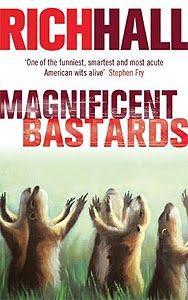
    #85 Magnificent Bastards, by Rich Hall (Abacus)

    I'm a big fan of the stand-up comedy of Rich Hall, one of the more intelligent and laconic comedians on the current circuit, but Magnificent Bastards, his collection of tall tales, didn't inspire the same pleasure.

    It's perfectly fine, and there are some nice touches within the short stories, particularly with regard to the creation of some quirky characters. But the collection is quite disparate and never really gels together to become a greater sum than its parts.

    The best story is of a man who vacuums prairie dogs as he plots to reclaim his family home, but on the flip side there is a bizarrely hyperbolic tale of a girl who invites 45,000 MySpace friends to a party at her house.

    So, rating time:

    #85 Magnificent Bastards, by Rich Hall (Abacus) - 6/10

    Next up: The Heart of a Goof, by PG Wodehouse (Everyman's Library)

  • Click here for the full list of books so far, and their rating